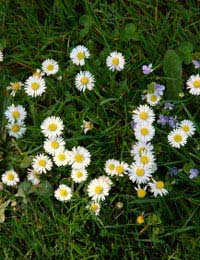
Few things arouse more passion amongst keen gardeners than weeds – and seldom are they less welcome than when they show up on an otherwise perfect lawn.
Of the hundreds of varieties of wildflowers to be found in the British countryside, only 25 or so are what you’d really call lawn weeds, though that’s precious little consolation when it’s your grass they’re ruining. Success in keeping your lawn weed-free often depends on knowing your enemy really well, and even with so few “foes” to recognise, it can often be hard work.
So how well do you know weeds? Can you tell speedwell from silverweed at a glance, or are daisies and dandelions all the same to you?
Test your knowledge of weeds and their management with this quick questionnaire; with a bit of luck it might even help you win the battle. The answers are at the bottom – good luck!
1. Which of the following can contribute to weed problems?
- a) Close mowing
- b) Lawn feeding
- c) Scarifying the lawn
2. Selective weed-killers can be a great help – but what against?
- a) Weed grasses
- b) Broad-leafed weeds
- c) Mosses
3. Weeds tend to grow either in rosettes or mats. Which do each of these do?
- a) Pearlwort
- b) Clover
- c) Dandelion
- d) Yarrow (or milfoil)
- e) Plantain
4. Speedwell can be a serious lawn nuisance – but how is it spread?
- a) Stem fragments spread by mowing.
- b) Wind-blown seeds.
- c) Creeping stems that release spores at intervals.
5. What makes milfoil (also called yarrow) such a menace?
- a) It’s impossible to dig out, even as a single isolated plant.
- b) It has grass-like leaves, so it’s impossible to see until it’s too late.
- c) It is resistant to weed-killers.
6. Where is silverweed likely to be a problem?
- a) In poorly drained, boggy or neglected lawns
- b) On open, sandy soils
- c) In fine leafed turf, or on chalky spoils.
7. What is “Yorkshire Fog” and why is it a problem?
- a) An annual meadow grass that is rapidly invasive.
- b) A coarse-leaved grass that grows in ugly tufts.
- c) An upright moss that kills off quality lawn grasses.
8. Why is the Creeping Buttercup so named?
- a) It has creeping stems that run along the ground and root at intervals.
- b) Plants quickly grow so large that they seem to creep over the lawn.
- c) Its has large seed pods which blow across the grass like a creeping insect.
9. Why is Glyphosate the wrong weed-killer to use on a lawn?
- a) It’s a fungicide and so won’t kill any of the weeds.
- b) It is a selective weed-killer so it won’t kill all of the weeds.
- c) It is non-selective and kills everything – including your lawn grass.
10. Which of the following can contribute to moss in a lawn?
- a) Poor surface drainage
- b) Shade
- c) Low soil nutrients
- d) All of the above
- e) None of the above
Answers
1. (a) Mowing too closely or, even worse, scalping the lawn can weaken the grass and create ideal conditions for weeds to colonise.
2. (b) Selective weed-killers are suitable for broad-leaved weeds.
3. (a) Pearlwort, (b) Clover and (d) Yarrow are mat-forming weeds, while (c) Dandelion and (e) Plantain are form rosettes. One point for each.
4. (a) Speedwell is spread by stem fragments flicked up by mowing; using a box to collect the cut grass is essential.
5. (c) Like woodrush, milfoil is resistant to weed-killers.
6. (a) Silverweed is most likely to be a nuisance for poorly drained, boggy or neglected lawns.
7. (b) Yorkshire Fog is a notorious coarse-leaved grass that grows into unsightly tufts on the lawn.
8. (a) The Creeping Buttercup has creeping stems that run along the ground and root at intervals. It is a common weed in British lawns, especially where the soil tends to be heavy and damp.
9. (c) It is non-selective and will kill all kinds of plants, including grass. This can be useful if you want to eradicate weed grasses from paths and patios, but it is obviously not the right choice for shifting dandelions from your lawn!
10. (d) All of these factors can contribute to moss in the lawn and the only effective, long-term way of banishing moss once and for all is to address the underlying conditions that encourage it. One point if you answered any one of (a), (b) or (c) – and TWO points if you answered (d).
So, How Did You Do?
- 15, Fine-grade turf
- 9 – 14, In clover
- 3 – 8, Buttercups and daisies
- 0 – 2, Yorkshire Fog